How Much Does an Aluminum Truck Bed Cost? 9 Things That Set the Price
There's no single price for an aluminum flatbed. Here's what moves the number, why aluminum costs more up front than steel, and how to get a firm quote for your truck.

There's no single price for an aluminum truck bed, because no two beds are built the same. The cost is set mainly by the bed size your truck needs, the gates, the rear bumper, and the options you add, such as tool boxes, a liftgate, racks and a hitch. Aluminum also costs more per pound than steel, so an aluminum flatbed usually costs more up front than a comparable steel one. The reliable way to get a number is a firm quote for your truck, which we send by email or text within 2 business days.
Below are the nine things that move the price the most, what each one changes, and what to decide before you ask. Most of them are the same questions our quote form asks.
The 9 price factors at a glance
| Factor | What changes the price | Decide before you ask |
|---|---|---|
| 1. Bed size | Width and length set how much aluminum goes into the deck, frame and mounts | Your truck's year, make and model, and what's on it now |
| 2. Gates | Style, height and how many sides get gates | Fold down, lift out, a mix, a custom height, or no gates |
| 3. Rear bumper | Keeping the factory bumper or adding a dock style bumper | How you back up, load and dock |
| 4. Camera and lighting | Planning around a factory backup camera; adding a reverse camera or LED work lights | Whether your truck has a factory backup camera |
| 5. Tool boxes | How many, how big, topside or underbody | What needs to lock up, and where you want to reach it |
| 6. Liftgate | Adding a hydraulic liftgate to the rear of the bed | Your heaviest regular load |
| 7. Racks, tie-downs, hitch | Each add-on is more material and labor | What you carry and whether you tow |
| 8. Finish and custom work | Powder coat, stainless hardware, custom headboards and one-off features | Whether you need a color, extra corrosion protection or a special feature |
| 9. Install or ship | Install at our Orange, CA shop, or freight to your location | Whether you can bring the truck to Orange |
1. Bed size and the truck it goes on
Bed size is the starting point for every quote. A longer, wider bed takes more aluminum in the deck, frame and crossmembers, and more time to build. The truck sets the size. From our past builds, a Toyota Tacoma most often gets a 6' × 6'6" bed, an F-150 or Silverado 1500 most often a 6'6" × 9', and dual rear wheel trucks like the F-350, Silverado 3500 and Ram 3500 run from 8' × 9' to 8' × 12'. Every bed is still measured to the truck. Our flatbed size guide lists more sizes.
2. Gate style, height and how many sides
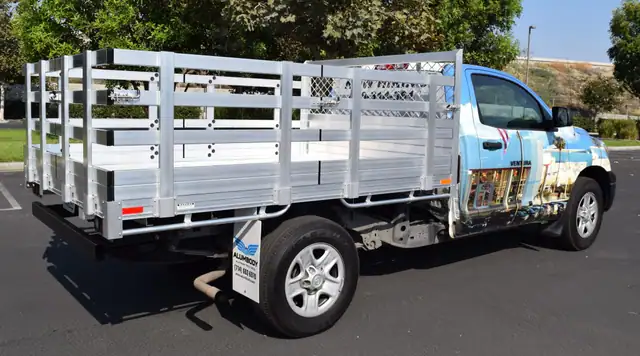
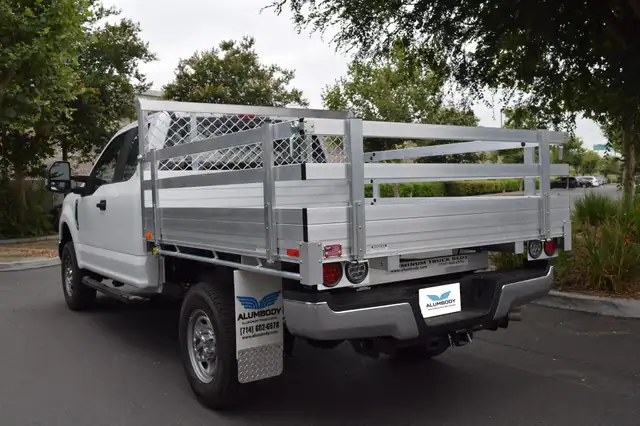
Gates are the sides of the bed, and each one adds framing and hardware. Taller gates use more aluminum than short ones, and gates on three sides cost more than an open deck. Our standard choices are 22" fold down gates and 30", 38" or 41" lift out gates. We've also built custom heights as low as 9", permanent 48" sides and barn doors in the rear. Mixing styles is common, such as lift out sides with a fold down rear gate. You can compare them on our gates page.
3. Factory bumper or dock style bumper
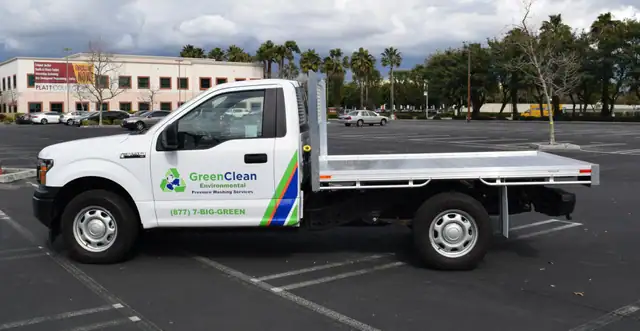
You can keep your truck's factory rear bumper or add a flat dock style bumper built for backing up to loading docks. We've also built two-step dock bumpers. The choice changes how the rear of the bed is built, so it's priced into the quote. If you're not sure which fits your work, the quote form lets you ask us to recommend one.
4. Backup camera and lighting
If your truck has a factory backup camera, tell us, so we can plan the rear of the bed around it. It's one of the first questions on our quote form. Every bed also needs working stop, tail and turn lights, and extras such as a reverse camera or LED work lights add parts and wiring time. Our warranty covers lighting for 1 year.
5. Tool boxes: how many and how big
Each tool box is more aluminum, hardware and mounting, so both the count and the size matter. Topside boxes sit on the deck along the sides. Underbody boxes hang below the deck and keep it clear. Sizes from our past builds range from compact 14" × 12" × 18" underbody boxes to 88"-long topside boxes. See our tool box options.

6. Liftgate
A hydraulic liftgate is a major add-on. The unit itself is a significant part of the cost, and it has to be fitted to the rear of the bed. We offer two: the Tommy Gate G2-Series, our most popular liftgate, with dual hydraulic cylinders for an even lift, and the Maxon 66-16, with a 1,600 lb capacity, which suits F-250/F-350 and Silverado/Ram 2500–3500 trucks. More on our liftgates page.

7. Racks, tie-downs and a hitch
Ladder racks, pipe and lumber racks, D-rings and other tie-downs, and a hitch receiver each add material and labor, and several together add up. Decide what you actually carry. Long ladders or pipe call for a rack. If you tow, ask for a hitch in the original quote so it's planned with the bumper.
8. Finish, hardware and custom work
Aluminum doesn't need paint to keep from rusting, so a coating is a choice, not a requirement. If you want a color, ask about powder coating; we've built a powder-coated matte black Ram 2500 flatbed. Stainless steel hardware is available for wet or cold climates. One-off features, such as a tapered or custom headboard, L-track, rope rails, or a cone drop and arrow board rack on a traffic-control body, add design and build time.

9. Installed in Orange or shipped to you
You can have the bed installed at our shop in Orange, California, or we can ship it anywhere in the U.S., palleted, shrink-wrapped and freight insured. Freight depends on where the bed is going, and with shipping you'll need to plan for installation on your end. That's why the quote form asks which one you want.
Why does an aluminum truck bed cost more than steel?
Aluminum costs more per pound than steel, so an aluminum bed usually costs more up front than a comparable steel bed. There's an engineering reason too: aluminum is about one-third as stiff as steel, so aluminum structures use deeper or thicker sections to carry the same load. You're paying for a lighter material, not a thinner bed. Here's what you get back:
- Weight. Aluminum weighs about one-third as much as steel by volume. A finished bed isn't one-third the weight, because the sections are sized differently, but it is significantly lighter, which leaves more of your truck's payload for cargo.
- No rust. Rust is iron oxide, and aluminum has no iron to rust. It forms a thin oxide layer that protects the surface, so there's no rust to grind out and no repainting to keep it from spreading. Aluminum can still corrode in some conditions, such as contact with a dissimilar metal when moisture is present, which is why hardware choices matter.
- Longevity. Rust is one of the most common reasons steel beds need repair or replacement. Taking it out of the picture is a big part of why people choose aluminum for a truck they plan to keep.
“I was skeptical at first but, as you said, I'd save money in gas, and I am.”
— Dennis, DownStream Services
If you're weighing the two materials side by side, our aluminum vs. steel comparison goes deeper.
How to get a firm quote
The quote form walks you through the same choices covered above. It asks for:
- Gate setup: 22" fold down, 30" or 38" lift out, no gates, or a custom height
- Rear bumper: keep the factory bumper or add a dock style bumper
- Whether your truck has a factory backup camera
- What's on the truck now: short bed, standard bed, long bed, or a bare cab and chassis
- Install at our Orange shop or ship to you
- Add-ons: liftgate, tool boxes, ladder or pipe rack, hitch, extra tie-downs, or a pool service setup
- Your truck's year, make and model
Most steps have a "not sure" option, and we'll recommend a setup for your work. You'll get a firm quote by email or text within 2 business days. Standard flatbeds and stake beds typically take 2–4 weeks to build; heavily customized builds may take longer. You can also call (714) 602-6970, Monday through Friday, 8:00 AM to 4:00 PM.
Frequently asked questions
How much does an aluminum flatbed cost?
It depends on the bed size, gates, bumper, tool boxes, liftgate and other options, so the reliable number is a quote for your truck. Alumbody sends a firm quote by email or text within 2 business days.
Why are aluminum truck beds more expensive than steel?
Aluminum costs more per pound than steel, and because it's less stiff, aluminum structures use deeper or thicker sections. In return you get a significantly lighter bed that won't rust.
Is an aluminum truck bed worth the extra cost?
It depends on how you use the truck. If payload, rust and keeping the truck for years matter to you, aluminum is usually the better fit; if the lowest up-front price matters most, steel costs less to buy.
How long does it take to build an aluminum flatbed?
Standard flatbeds and stake beds typically take 2–4 weeks. Heavily customized builds may take longer.
Can Alumbody ship a truck bed to me?
Yes. We ship anywhere in the U.S., palleted, shrink-wrapped and freight insured, or you can have the bed installed at our shop in Orange, California.