What Are Truck Beds Made Of? Aluminum Alloys, 6061-T6 and Tempers Explained
A plain-English guide to factory bed materials, the aluminum alloy series, what T6 means, how welding heat affects aluminum, and why hardware choice matters.

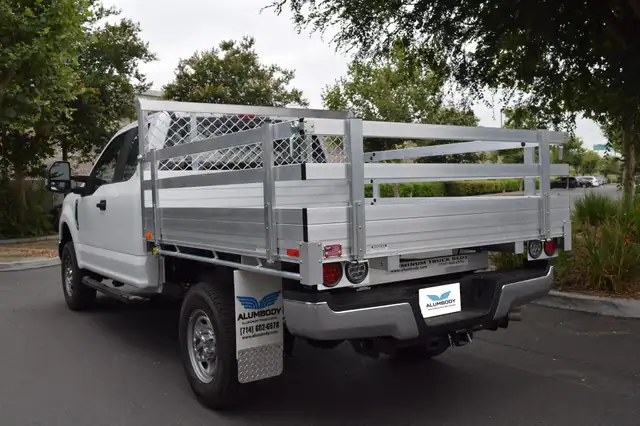
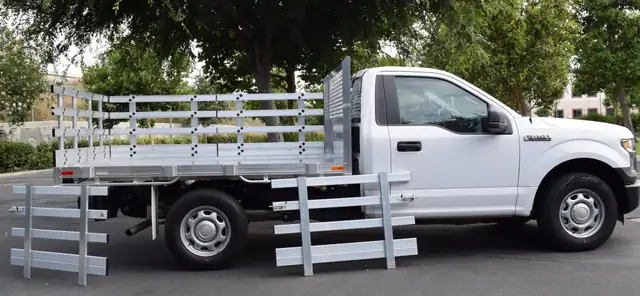
Factory pickup beds are made of steel, aluminum or composite, depending on the truck. Replacement flatbeds and stake beds are usually steel or aluminum. Aluminum beds can be built from several alloys; 6000-series alloys such as 6061 are among the most widely used for structural and transportation work because they balance strength, corrosion resistance and ease of extrusion. Alumbody builds with high strength 6000 series aluminum, with 6061-T6 aluminum extrusion in the gate frames and stainless steel hinges, latches and pins.
What are pickup truck beds made of?
Pickup frames are steel, but the bed on top varies by model. Here's how several popular trucks are built:
| Truck | Bed and body materials |
|---|---|
| Ford F-150 (2015 and newer) | Aluminum-alloy body and bed on a steel frame |
| Ford Super Duty F-250/F-350/F-450 (2017 and newer) | Aluminum cab, body skin and bed on a mostly high-strength-steel frame |
| Ford Ranger (2019 and newer) | Mostly steel body and a steel bed; aluminum hood and front fenders |
| Chevy Silverado (2019 and newer) | Steel bed, fenders, roof and cab structure; aluminum doors, hood and tailgate |
| GMC Sierra | Shares the Silverado's mixed-material approach |
| Ram 1500 (2019 and newer) | Mostly steel; aluminum hood and tailgate |
| Toyota Tundra (2022 and newer) | Composite (sheet-molded compound) bed with aluminum cross members, on a steel frame |
For more detail by brand, see which trucks have aluminum bodies. When the factory bed comes off for a flatbed or stake bed, the choice usually comes down to steel or aluminum, which we compare in aluminum vs. steel truck beds.
How aluminum alloys are grouped
Wrought aluminum alloys use a four-digit number. The first digit names the series, which tells you the main alloying element and how the alloy gets its strength. Some series are heat-treatable, meaning controlled heating and cooling make them stronger. Others are strengthened by cold working, called strain hardening.
| Series | Main alloying element | Heat-treatable? | Typical uses |
|---|---|---|---|
| 1xxx | None (99% or more aluminum) | No | Electrical conductors, foil, heat-exchanger fins |
| 2xxx | Copper | Yes | Aircraft structures, high-strength machined parts |
| 3xxx | Manganese | No | Cookware, roofing and siding, beverage can bodies |
| 4xxx | Silicon | Some alloys | Welding and brazing filler |
| 5xxx | Magnesium | No | Sheet and plate for tanks, trailers, boats and pressure vessels |
| 6xxx | Magnesium and silicon | Yes | Extrusions, structural shapes, transportation and architectural work |
| 7xxx | Zinc | Yes | Aircraft structures, high-strength sporting goods |
Every series has jobs it does well. The right alloy depends on the part: whether it's sheet, plate or an extruded shape; whether it will be welded, formed or machined; and what loads and environment it will see.
Why 6000-series aluminum is used for structural work
6000-series alloys contain magnesium and silicon. They're heat-treatable, have good corrosion resistance, can be welded with the right procedures and filler, and extrude well. 6061 is one of the most widely used structural aluminum alloys, and 6000-series extrusions show up across structural, architectural and transportation work.
Extrusion is a big part of the appeal. The metal is pushed through a shaped die to make long pieces with a constant cross-section, which makes it practical to produce channels, I-beams, tubes and custom profiles. That matters because aluminum is about one-third as stiff as steel (a modulus of about 10,000 ksi versus about 29,000 ksi), so aluminum structures rely on deeper, well-shaped sections for rigidity.
How we use it
- Bed material: high strength 6000 series aluminum.
- Mounts: heavy-wall aluminum C-channel or I-beam crossmembers.
- Gate frames: 6061-T6 aluminum extrusion. See our gate options.
- Floor: 8,000 lb distributed load rating, in most cases more than the truck's GVWR. The truck's payload, GVWR and axle ratings always govern.
The full list of specs is on our bed features page.

What does T6 mean? Aluminum tempers in plain terms
The letters and numbers after the alloy, like the T6 in 6061-T6, are the temper. The temper tells you how the metal was processed, and therefore how strong and formable it is. The same alloy can be soft and easy to bend in one temper and much stronger in another.
- F: as fabricated, with no special control over strength.
- O: annealed, the softest and most formable condition.
- H: strain-hardened by cold working, used for non-heat-treatable alloys such as the 1xxx, 3xxx and 5xxx series.
- T: thermally treated. The digit after the T describes the process.
T6 means the metal was solution heat-treated (heated so the alloying elements dissolve evenly, then cooled quickly) and then artificially aged (held at a lower temperature so those elements form tiny particles that strengthen the metal). For 6061, T6 is a common high-strength temper with a typical yield strength of about 35–40 ksi. That's in the same range as A36 structural steel at about 36 ksi, at roughly one-third the weight. T4, by comparison, is solution heat-treated and then naturally aged at room temperature, which leaves the metal softer than T6.
How welding heat affects heat-treated aluminum
Welding heats the metal on either side of the joint, and that band is called the heat-affected zone. In a heat-treated alloy like 6061-T6, the heat partly undoes the heat treatment, so the metal next to an as-welded joint is weaker than the surrounding base metal.
This is a well-known property, not a defect, and it isn't limited to one alloy family: strain-hardened alloys also lose some of their cold-work strength near a weld. Design standards for aluminum structures publish reduced strength values for welded zones, and designers account for the effect by:
- Using the reduced, as-welded strength in calculations for welded parts.
- Keeping welds away from the highest-stress spots where possible.
- Sizing sections deeper or thicker near joints.
- Choosing a filler alloy suited to the base metal and the job.
- Cleaning off the oxide layer before welding and following a consistent welding procedure.
A welded part can be heat-treated again to recover strength, but that means running the full heat treatment on the finished assembly, so for large welded structures designers usually plan around the as-welded strength instead.
Why stainless steel hardware matters on an aluminum bed
Aluminum doesn't rust, but it can suffer galvanic corrosion. When two different metals touch and moisture bridges them, they form a small electrical cell, and the more active metal corrodes faster. Paired with steel or stainless steel, aluminum is the more active metal. Road salt makes that moisture more conductive, which speeds things up.
Stainless steel is the usual hardware choice for aluminum assemblies. It doesn't rust or leave rust streaks, and when small stainless fasteners sit in a much larger aluminum part, the galvanic effect is minor. Plain carbon steel hardware rusts once any plating wears off, and it sets up its own galvanic pairing with the aluminum around it. In very wet service, isolating washers, sealants or coatings can reduce metal-to-metal contact further.
On our beds, gate hinges are 304 stainless steel, and latches and locking pins are stainless steel. Stainless steel hardware is used on our pool truck beds and is available for trucks that work in wet or cold climates.

Questions to ask about aluminum truck bed material
- What alloy series is the bed built from, and what's used for the crossmembers and gates?
- What temper are the structural extrusions?
- What is the floor's load rating, and how does it compare with my truck's GVWR and payload?
- What hardware is used on the hinges, latches and pins?
- What does the warranty cover? Ours is 3 years structural and 1 year on lighting.
For more buying questions, see questions to ask before buying a truck bed.
Frequently asked questions
What are truck beds made of?
Factory pickup beds are steel, aluminum or composite depending on the model. For example, the Ford F-150 (2015 and newer) and Super Duty (2017 and newer) have aluminum beds, the 2019 and newer Chevy Silverado has a steel bed, and the 2022 and newer Toyota Tundra has a composite bed with aluminum cross members. Replacement flatbeds and stake beds are usually steel or aluminum.
Is 6061 aluminum good for a truck bed?
6061-T6 is one of the most widely used structural aluminum alloys, with good strength (a typical yield strength of about 35–40 ksi), corrosion resistance and extrudability. Our beds are built with high strength 6000 series aluminum, and our gate frames use 6061-T6 extrusion.
What does T6 mean in aluminum?
T6 means the alloy was solution heat-treated and then artificially aged to reach high strength. It's a common temper for 6061 and other heat-treatable alloys.
Does welding weaken aluminum?
In heat-treated alloys like 6061-T6, welding heat lowers the strength of the metal next to the weld, called the heat-affected zone. Designers account for it by using reduced as-welded strength values and sizing and placing joints accordingly.
Why use stainless steel hardware on an aluminum truck bed?
Stainless steel doesn't rust, and small stainless fasteners in a larger aluminum part keep galvanic corrosion minor. Plain steel hardware can rust and stain, and dissimilar metals in contact with moisture can corrode the aluminum.