Service Body vs. Flatbed with Tool Boxes: How the Right Bed Makes the Job Easier
What a service (utility) body is, how it compares with an aluminum flatbed or stake bed with tool boxes, and how to decide which setup fits your work.
A service body, also called a utility body or utility bed, replaces a pickup's bed with rows of lockable compartments along both sides and a cargo area down the middle. A flatbed gives you a full-width open deck instead, and you add topside and underbody tool boxes, racks and a liftgate where you need them. If your day is mostly tools and small parts, a service body is built around that. If you also haul materials, pallets, equipment or debris, a flatbed or stake bed with tool boxes covers much of the same storage need and keeps the deck open.
To be clear up front: Alumbody doesn't build service bodies. We've built aluminum flatbeds and stake beds in Orange, California, since 1978. Here's how the two setups compare, and how a flatbed can cover many of the same needs.
What is a service body?
A service body is a truck body built around enclosed storage. Compartments run along each side, usually the full length of the body, with doors that open from the outside so tools and parts can be reached from the ground. Between the two rows is a center cargo area, open on top, that loads from the rear. Many have shelves and bins inside the compartments, plus options like ladder racks or a liftgate.
They're popular with trades that carry lots of small parts and tools, such as plumbing, electrical, HVAC, utility and fleet maintenance work. People search for them as a service body truck bed, a utility bed or a utility body; the terms usually mean the same thing.
What is a flatbed with tool boxes?
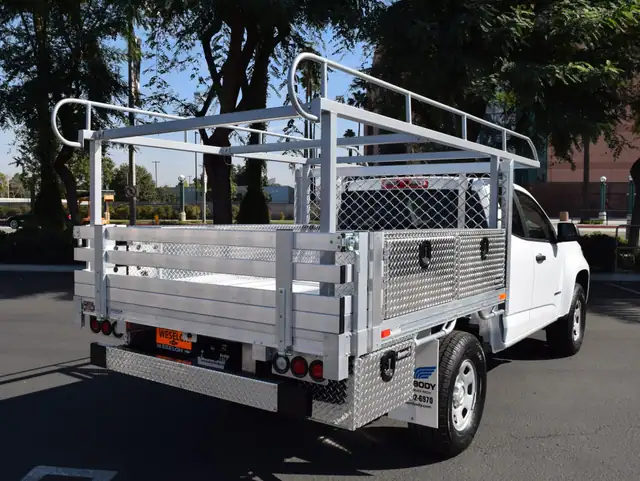
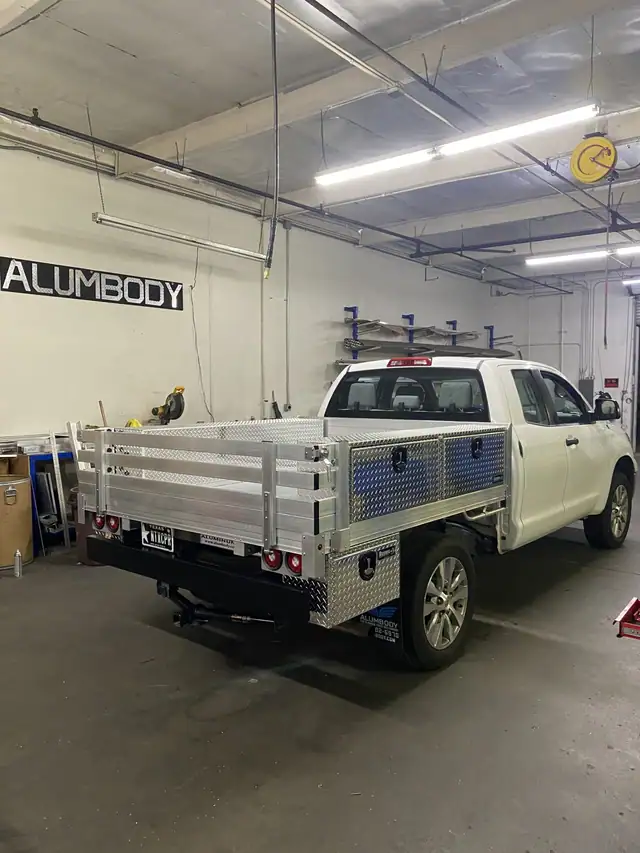
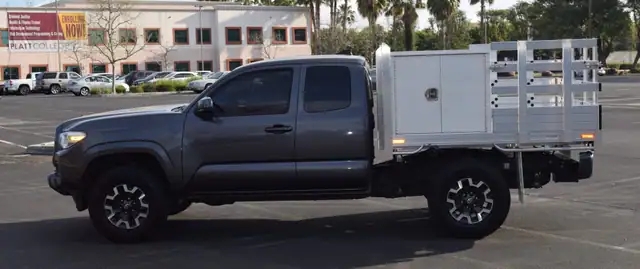
An aluminum flatbed replaces the pickup bed with a flat deck that sits above the wheels, so there are no wheel wells cutting into the floor. You add what your work needs:
- Topside tool boxes along the sides of the deck for everyday tools.
- Underbody tool boxes beneath the deck for heavier gear, leaving the top clear.
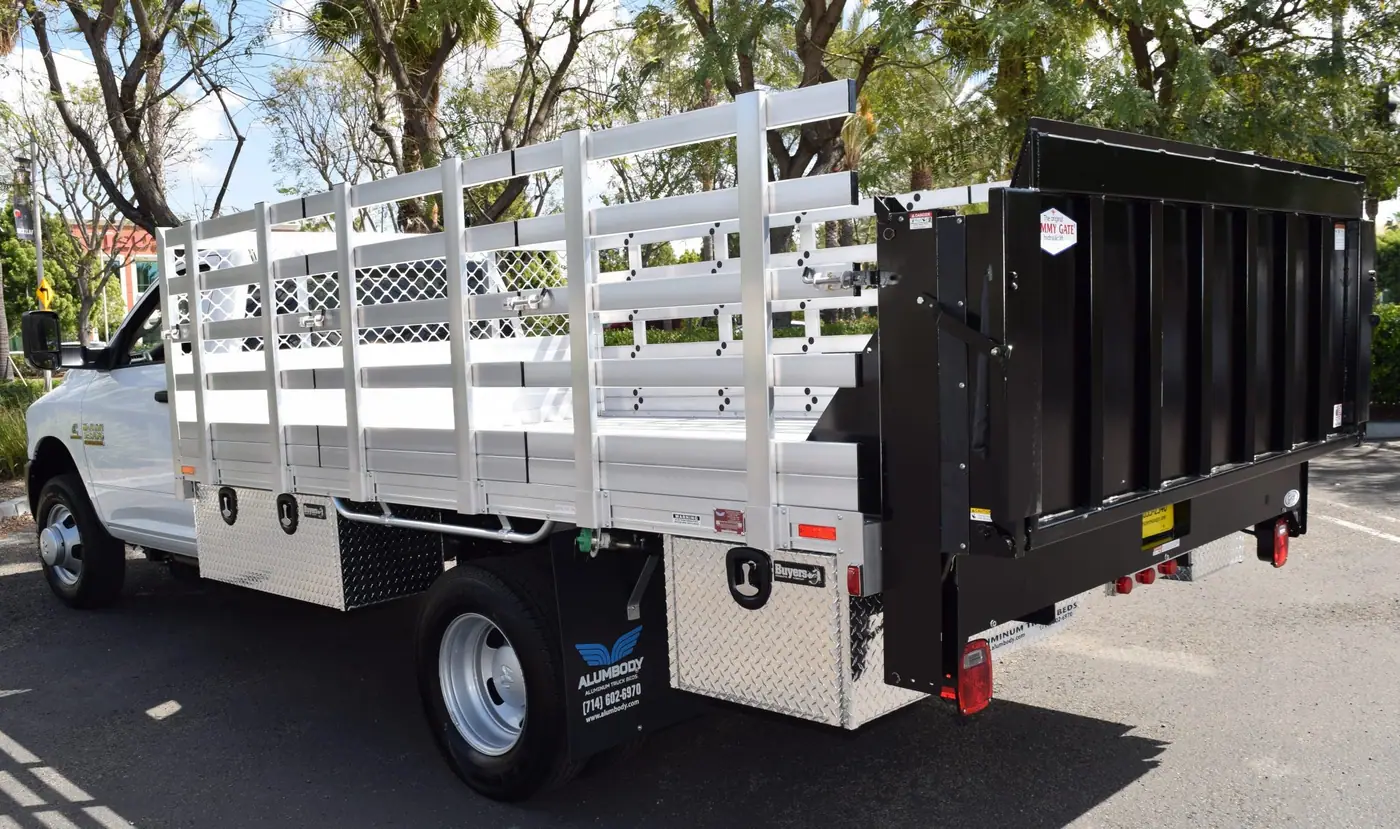
- Gates: 22" fold-down gates for side loading, or 30", 38" or 41" lift-out gates for taller sides on an aluminum stake bed.
- Ladder racks and pipe or lumber racks for long stock.
- A liftgate, either the Tommy Gate G2-Series or the Maxon 66-16, for heavy items.
- D-rings and tie-downs, LED work lights, a hitch and a reverse camera.
Service body vs. flatbed: side by side
| Service body (utility body) | Flatbed or stake bed with tool boxes | |
|---|---|---|
| Storage | Many enclosed compartments along both sides | Topside and underbody tool boxes sized to what you carry |
| Cargo area | A center bay between the compartments | A full-width deck; topside boxes use some of the width |
| Loading | Mostly from the rear | From the sides and rear; fold-down gates open the side for hand or forklift loading |
| Pallets and sheet goods | Limited by the width of the center bay | Lie flat on the deck |
| Long stock | Ladder or pipe racks | Ladder racks and pipe or lumber racks |
| Heavy items | Liftgate on many bodies | Tommy Gate G2-Series or Maxon 66-16 liftgate |
| Best fit | Lots of small parts and tools, little bulky cargo | A mix of tools and materials, equipment or debris |
When a service body is the better choice
If nearly everything you carry is tools, parts and supplies, you rarely haul anything bulky, and you want as much enclosed, lockable storage as the truck can hold, a service body is built for exactly that. It isn't something we build, and for that kind of work it can be the right call.
When a flatbed or stake bed with tool boxes is the better choice
- You haul materials, pallets or equipment as well as tools.
- You load from the side, by hand or with a forklift.
- You need a full-width deck some days and tool storage every day.
- You carry debris, mulch or other loose loads that need taller sides.
- You'd rather choose the size and position of each box than work around a fixed compartment layout.

How a flatbed setup covers service-body needs
Tools you can reach from the ground
Topside boxes put hand tools at the side of the truck, and underbody boxes keep heavier gear below the deck. Neither requires climbing onto the bed. Juan, whose contracting company runs Alumbody beds, described the difference:
“We now have easy access to any part of our truck beds at any time without having to climb in for supplies, and more overall space to fit all of our equipment.”
— Juan, Urban Graffiti Enterprises
Room for long stock
Ladder racks and pipe or lumber racks carry long items above the deck, so they don't take up floor space or tool box room.
A liftgate for heavy loads
A liftgate handles what's too heavy to lift by hand. We install the Tommy Gate G2-Series, our most popular, and the Maxon 66-16, which has a 1,600 lb capacity, and plan the rear of the bed around it.
An open deck when you need it
With fold-down gates down, the deck loads from the side like a platform. With lift-out gates in place, it works as a stake bed for loose or tall loads. Our floors have an 8,000 lb distributed load rating, which in most cases is more than the truck's GVWR, so the truck's own payload and axle ratings set the limit.
Real flatbed and stake bed setups with tool boxes
A few examples from past Alumbody builds. Sizes come from those trucks; every bed is measured to the truck it goes on.
- 2016 Ram 3500 dual rear wheel: 8'×12' stake bed with 38" lift-out stakes, four underbody tool boxes and a Tommy Gate liftgate.
- 2021 Ford F-350: 7'×9' stake bed with 30" lift-out sides, a liftgate, a hitch and four underbody tool boxes.
- 2021 Toyota Tundra: 7'×9' stake bed with 30" lift-out sides, a liftgate and four tool boxes.
- 2019 Mercedes-Benz Sprinter 3500: 7'6"×14' flatbed with 25" fold-down sides, a liftgate and two 18"×18"×60" tool boxes.

Questions to answer before you decide
- What do you carry every day, and what only some days?
- How much of it is bulky: pallets, sheet goods, equipment or debris?
- How do you load: by hand from the side, by forklift, or from the rear?
- What has to stay locked on the truck overnight?
- Do you need a liftgate now, or might you later?
- What truck is it going on, and what are its payload and axle ratings?
For layout ideas, see truck tool box configurations by trade and our tool box options. If the answers point to an open deck with tool storage, send them with your truck details through our quote form, and we'll reply with a firm quote by email or text within 2 business days.
Frequently asked questions
What is the difference between a service body and a flatbed?
A service body surrounds a center cargo bay with enclosed compartments along both sides. A flatbed is a full-width open deck, and you add topside or underbody tool boxes, racks and gates as needed.
Is a utility bed the same as a service body?
Usually, yes. Utility bed, utility body and service body are commonly used for the same type of compartment truck body.
Can you put tool boxes on a flatbed?
Yes. Topside boxes sit on the deck along the sides, and underbody boxes mount beneath the deck so the top stays clear. Many setups use both.
Does Alumbody build service bodies?
No. Alumbody builds aluminum flatbeds and stake beds, with options such as topside and underbody tool boxes, ladder and pipe racks, and Tommy Gate G2-Series or Maxon 66-16 liftgates.